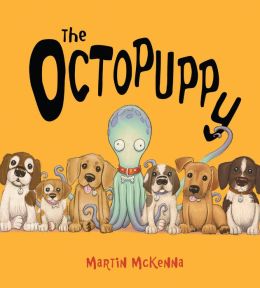
The Octopuppy. Martin McKenna. 2015. [March] Scholastic. 32 pages.
First sentence: Edgar wanted a dog. But Edgar didn't get a dog. He got Jarvis. Jarvis couldn't do anything a dog could do. But Edgar couldn't deny that Jarvis was clever.
Premise/Plot: Edgar, the hero, isn't pleased to receive an octopus instead of a puppy. He wants Jarvis to act just like a dog would. Jarvis is smart, and, now and then, Jarvis tries to act like a puppy. But he can't keep it up, Jarvis always goes back to being Jarvis. Edgar doesn't really appreciate that until it's too late. Jarvis does NOT want to stay where he's not wanted. Now that he's gone, Edgar regrets his behavior. Will these two be reunited.
My thoughts: What a strange, strange book. The good news? Well, readers can see for themselves and judge this book by its cover. The strangeness is not at all subtle. Did I like it? Not really. In fact, I really didn't like it at all. I found the scene where Jarvis flushes himself down the toilet to be disturbing!!! Will other readers like this plot twist? Perhaps! Who knows? But this book is not a good match for me.
Text: 2.5 out of 5
Illustrations: 2.5 out of 5
Total: 5 out of 10
Saturday, March 7, 2015
Friday, March 6, 2015
The Ship of Brides
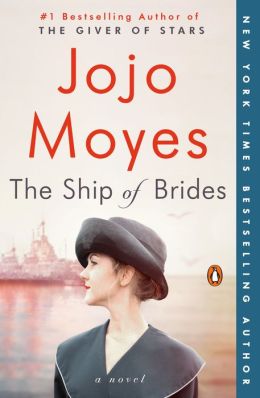
The Ship of Brides. Jojo Moyes. 2005/2014. Penguin. 464 pages.
Did I love absolutely everything about Jojo Moyes' The Ship of Brides? No, I can't say that I did. But I enjoyed it enough to read it in two days. I'll start with what I loved.
I loved the subject. I loved the idea of reading about a group of women--war brides--sailing together into the unknown. The book is about a ship full of Australian women--all war brides--sailing to England in 1946. It isn't any ship either. It's an aircraft carrier. The potential to mingle with the navy is definitely there, though obviously discouraged. There are over 600 women on board, though readers only get close to four women who share a room: Jean, Avice, Margaret, and Frances. They are sailing into the unknown in a way because they've never been to England, they've never met their in-laws, and they haven't seen their husbands in months or even years. Take into consideration, that some of these couples only knew each other a few weeks before they got married, and, yes there is plenty of unknown ahead. Even if they felt like they *knew* their husbands when they got married, they don't know how the war has changed them, if the war has changed them. The time on the ship is an in-between time: the first taste of a big change in all their lives. Will they be happy? Will it all work out? Are they still loved? Are they still wanted? Several women receive messages--telegrams, I believe-telling them NOT to come.
I liked the narration, especially of the time on the ship. The days/weeks are chronicled, and, one gets a sense of the experience, of the journey. The anxiety, the awkwardness, the heat, the opportunities, the stresses, etc. I thought the setting was well done, for the most part.
Did I love the characterization? Not as much as I hoped initially. I don't know if there was any one character that I loved. And some of the characterization felt a bit uneven.
What I didn't quite love was the framework. The beginning and ending felt a little off to me. Readers first meet a grandmother and a granddaughter on their trip in India. The two just happen to stumble upon a ship about to become scrap. It is THE ship, and it overwhelms the grandmother to see it. The rest of the book is about the four women--really, just three women if I'm honest--and tries, I suppose, to keep readers guessing which of the three is the grandmother of the future. The ending is part of that framework: readers finally knowing how it all fits together.
I liked it. I'm glad I read it. I am. I'm interested in the subject. I would be happy to read more books like it. But it wasn't love for me.
Did I love absolutely everything about Jojo Moyes' The Ship of Brides? No, I can't say that I did. But I enjoyed it enough to read it in two days. I'll start with what I loved.
I loved the subject. I loved the idea of reading about a group of women--war brides--sailing together into the unknown. The book is about a ship full of Australian women--all war brides--sailing to England in 1946. It isn't any ship either. It's an aircraft carrier. The potential to mingle with the navy is definitely there, though obviously discouraged. There are over 600 women on board, though readers only get close to four women who share a room: Jean, Avice, Margaret, and Frances. They are sailing into the unknown in a way because they've never been to England, they've never met their in-laws, and they haven't seen their husbands in months or even years. Take into consideration, that some of these couples only knew each other a few weeks before they got married, and, yes there is plenty of unknown ahead. Even if they felt like they *knew* their husbands when they got married, they don't know how the war has changed them, if the war has changed them. The time on the ship is an in-between time: the first taste of a big change in all their lives. Will they be happy? Will it all work out? Are they still loved? Are they still wanted? Several women receive messages--telegrams, I believe-telling them NOT to come.
I liked the narration, especially of the time on the ship. The days/weeks are chronicled, and, one gets a sense of the experience, of the journey. The anxiety, the awkwardness, the heat, the opportunities, the stresses, etc. I thought the setting was well done, for the most part.
Did I love the characterization? Not as much as I hoped initially. I don't know if there was any one character that I loved. And some of the characterization felt a bit uneven.
What I didn't quite love was the framework. The beginning and ending felt a little off to me. Readers first meet a grandmother and a granddaughter on their trip in India. The two just happen to stumble upon a ship about to become scrap. It is THE ship, and it overwhelms the grandmother to see it. The rest of the book is about the four women--really, just three women if I'm honest--and tries, I suppose, to keep readers guessing which of the three is the grandmother of the future. The ending is part of that framework: readers finally knowing how it all fits together.
I liked it. I'm glad I read it. I am. I'm interested in the subject. I would be happy to read more books like it. But it wasn't love for me.
Thursday, March 5, 2015
Unlikely Pilgrimage of Harold Fry
The Unlikely Pilgrimage of Harold Fry. Rachel Joyce. 2012. Random House. 320 pages.
The novel opens with Harold Fry receiving a letter in the mail from a former friend, Queenie Hennessy; it is a goodbye letter. Though they haven't seen each other in decades, she wanted to tell him that she was dying of cancer. He's shocked, to put it mildly. Though in all honesty he doesn't think of her all that often, now that her letter is in his hands, he is remembering the woman he once worked with and what she once did for him. He writes a reply and prepares to mail it, but, on his way to the mailbox, it doesn't seem enough, not nearly enough. His reply is so short and inadequate. So after a brief conversation with a stranger about cancer, he decides to have a little faith and embark on a pilgrimage. He will walk to see Queenie in her hospice home. In his mind, logical or not, he's connected the two: walking and healing. He'll do the walking, but will it work?
The Unlikely Pilgrimage of Harold Fry is a character-driven, journey-focused read. From start to finish, readers are given a unique opportunity to walk with Harold Fry, to really get inside his head and understand him inside and out. It's a bit of a mystery as well. Since readers learn things about Harold chapter by chapter by chapter. The book is very much about Harold making sense of Harold: that is Harold coming to know himself better, of making peace if you will with the past and present.
I liked the book very much for the chance to get to know Harold and even his wife. (At first, his wife thinks he's CRAZY. Crazy for thinking up the idea, crazier still for acting on it. It just does not make any sense at all to her. WHY WALK OVER 500 MILES TO SEE A FORMER COWORKER YOU HAVEN'T SEEN IN TWO DECADES?!
It was a very pleasant read. Harold meets people every single day of his walk, and the book is a book of conversations.
It is set in England.
The novel opens with Harold Fry receiving a letter in the mail from a former friend, Queenie Hennessy; it is a goodbye letter. Though they haven't seen each other in decades, she wanted to tell him that she was dying of cancer. He's shocked, to put it mildly. Though in all honesty he doesn't think of her all that often, now that her letter is in his hands, he is remembering the woman he once worked with and what she once did for him. He writes a reply and prepares to mail it, but, on his way to the mailbox, it doesn't seem enough, not nearly enough. His reply is so short and inadequate. So after a brief conversation with a stranger about cancer, he decides to have a little faith and embark on a pilgrimage. He will walk to see Queenie in her hospice home. In his mind, logical or not, he's connected the two: walking and healing. He'll do the walking, but will it work?
The Unlikely Pilgrimage of Harold Fry is a character-driven, journey-focused read. From start to finish, readers are given a unique opportunity to walk with Harold Fry, to really get inside his head and understand him inside and out. It's a bit of a mystery as well. Since readers learn things about Harold chapter by chapter by chapter. The book is very much about Harold making sense of Harold: that is Harold coming to know himself better, of making peace if you will with the past and present.
I liked the book very much for the chance to get to know Harold and even his wife. (At first, his wife thinks he's CRAZY. Crazy for thinking up the idea, crazier still for acting on it. It just does not make any sense at all to her. WHY WALK OVER 500 MILES TO SEE A FORMER COWORKER YOU HAVEN'T SEEN IN TWO DECADES?!
It was a very pleasant read. Harold meets people every single day of his walk, and the book is a book of conversations.
It is set in England.
Wednesday, March 4, 2015
The Last Jews in Berlin
The Last Jews in Berlin. Leonard Gross. 1982/2015. Open Road Media. 343 pages.
The Last Jews in Berlin was a good read. It was oh-so-close to being a great read every now and then. What I loved about this one were the personal stories. These stories were the heart of the book. Readers get to meet dozens of people and follow their stories. As you can imagine, these stories can be intense.
Instead of telling each person's story one at a time, one after the other, the book takes a more chronological approach. The book is told in alternating viewpoints. Is this for the best? On the one hand, I can see why this approach makes it more difficult for readers to follow individuals, to keep track of each person's story. Just when you get good and attached to a certain person's narrative, it changes. It takes a page or two perhaps before you reconnect with the next narrator and get invested in that unfolding story. On the other hand, telling the story like this sets a certain tone, increases tension and suspense, and avoids repetition. So I can see why it makes sense. The method of storytelling didn't bother me.
Probably the one thing I learned from reading this is that there were Jews working with the Nazis and turning other Jews in. That there were Jews betraying one another trying to survive. One simply didn't know who to trust.
At the same time, the book shares stories of people who were trustworthy, people who were willing to risk their own lives to help Jews. Life was hard for everyone: but some were willing to share their food and open up their homes at great risk. The book did show that not every person supported the Nazis and their philosophy. There were people who disagreed and were willing to do the right thing.
It's an emotional book, very intense in places.
The Last Jews in Berlin was a good read. It was oh-so-close to being a great read every now and then. What I loved about this one were the personal stories. These stories were the heart of the book. Readers get to meet dozens of people and follow their stories. As you can imagine, these stories can be intense.
Instead of telling each person's story one at a time, one after the other, the book takes a more chronological approach. The book is told in alternating viewpoints. Is this for the best? On the one hand, I can see why this approach makes it more difficult for readers to follow individuals, to keep track of each person's story. Just when you get good and attached to a certain person's narrative, it changes. It takes a page or two perhaps before you reconnect with the next narrator and get invested in that unfolding story. On the other hand, telling the story like this sets a certain tone, increases tension and suspense, and avoids repetition. So I can see why it makes sense. The method of storytelling didn't bother me.
Probably the one thing I learned from reading this is that there were Jews working with the Nazis and turning other Jews in. That there were Jews betraying one another trying to survive. One simply didn't know who to trust.
At the same time, the book shares stories of people who were trustworthy, people who were willing to risk their own lives to help Jews. Life was hard for everyone: but some were willing to share their food and open up their homes at great risk. The book did show that not every person supported the Nazis and their philosophy. There were people who disagreed and were willing to do the right thing.
It's an emotional book, very intense in places.
Tuesday, March 3, 2015
The Case of the Cursed Dodo
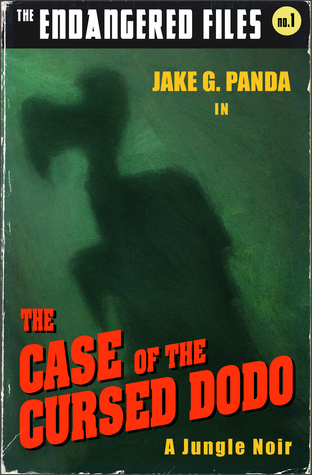
The Case of the Cursed Dodo: A Jungle Noir (Endangered Files #1) Jake G. Panda. 2014. Wooly Family Studios. 180 pages.
More jungle noir, please! More, more, more! So yes, it's safe to assume that I loved "watching" Jake G. Panda in The Case of the Cursed Dodo. The book is written in movie/script format. Which could just have easily failed as succeeded, but, in this case worked quite well.
What did I love about The Case of the Cursed Dodo? Well, I loved, loved, loved the writing. More specifically the descriptions. Practically perfect in every way. I'll just share a few favorite bits:
More jungle noir, please! More, more, more! So yes, it's safe to assume that I loved "watching" Jake G. Panda in The Case of the Cursed Dodo. The book is written in movie/script format. Which could just have easily failed as succeeded, but, in this case worked quite well.
What did I love about The Case of the Cursed Dodo? Well, I loved, loved, loved the writing. More specifically the descriptions. Practically perfect in every way. I'll just share a few favorite bits:
That's Gloria. A dizzy grizzly who runs the front desk of this bunkhouse. She's a one of kind dame.and
"Thanks, Gloria," Jake says, taking the letters. She gives him a big wink.
"Anytime, Honey."
I wish she wouldn't call me that. It makes me feel all sticky. Besides, if there's one thing I ain't, it's sweet. (13)
Ernie's the hotel driver. A thick-skinned pachyderm with a chip on his shoulder. He lost his tusks in a hunting accident. And he's not the kinda guy to quickly forget. But I had a soft spot for the big fella. He had a lead foot and worked for peanuts. (21)So the premise if you haven't guessed it is that the hero is a detective. Jake G. Panda is "in the protection racket. I'm the Last Resort's house dick. The hotel snoop. The resident fuzz. It's my job to keep the guests safe and outta harm's way" (9). The first case involves a missing hare (Professor Harry), a mysterious long-buried suitcase, and a 'cursed dodo.' Plenty of action and humor. Just a treat to read.
Monday, March 2, 2015
Farewell to the East End
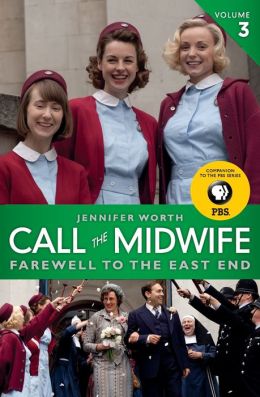
Farewell to the East End. (Call of the Midwife #3) Jennifer Worth. 2009/2013. HarperCollins. 336 pages.
I still haven't read the first book in the Call The Midwife series by Jennifer Worth, but, I have watched and enjoyed the first two series of the show, an adaptation of the books. I loved the second book, Shadows of the Workhouse. I'm not sure I "loved" the third book, Farewell to the East End. I suppose you could say I found it equally fascinating and disturbing. The stories are definitely darker and heavier--dismal and bleak. Mixed in with stories are a handful of research chapters about various topics.
Highlights (not highlights because of 'hope') include several chapters focused on twins Megan and Mave, several chapters focusing on the Masterson family, several chapters focusing on the Harding family, and several chapters focusing on Chummy.
One of the most haunting stories, in my opinion, is "The Captain's Daughter." Chummy is called aboard a merchant ship to tend a woman with stomach cramps. The woman believes she's just had too many apples. But it soon becomes apparent to Chummy that all is not right. The woman is in fact pregnant and in labor, and, the father could be any of the crew including her own father, the Captain. Chummy learns that she's been on board and servicing the men--keeping them all happy--since the age of fourteen, soon after her mother's death. Chummy is a bit shocked--who wouldn't be--but very practical and down to earth. The birth is challenging and quite memorable.
I still haven't read the first book in the Call The Midwife series by Jennifer Worth, but, I have watched and enjoyed the first two series of the show, an adaptation of the books. I loved the second book, Shadows of the Workhouse. I'm not sure I "loved" the third book, Farewell to the East End. I suppose you could say I found it equally fascinating and disturbing. The stories are definitely darker and heavier--dismal and bleak. Mixed in with stories are a handful of research chapters about various topics.
Highlights (not highlights because of 'hope') include several chapters focused on twins Megan and Mave, several chapters focusing on the Masterson family, several chapters focusing on the Harding family, and several chapters focusing on Chummy.
One of the most haunting stories, in my opinion, is "The Captain's Daughter." Chummy is called aboard a merchant ship to tend a woman with stomach cramps. The woman believes she's just had too many apples. But it soon becomes apparent to Chummy that all is not right. The woman is in fact pregnant and in labor, and, the father could be any of the crew including her own father, the Captain. Chummy learns that she's been on board and servicing the men--keeping them all happy--since the age of fourteen, soon after her mother's death. Chummy is a bit shocked--who wouldn't be--but very practical and down to earth. The birth is challenging and quite memorable.
Sunday, March 1, 2015
Meet Inspector Barnaby
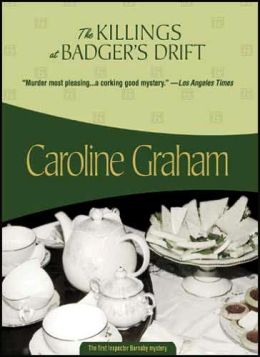
The Killings At Badger's Drift. (Inspector Barnaby #1) Caroline Graham. 1987/2005. Felony & Mayhem. 272 pages.
I'm so glad I checked out The Killings at Badger's Drift on a whim!!! It's always a good thing to browse in the library!
The Killings at Badger's Drift is the first book in the Inspector Barnaby mystery series. Readers meet Detective Chief Inspector Barnaby and Sergeant Troy (his assistant). I definitely liked Inspector Barnaby!!!
The first character readers meet is Miss Emily Simpson, a spinster who stumbles upon something she shouldn't see in the woods. That knowledge will lead to her death...readers however are not told exactly what she saw--or WHO she saw...leaving plenty of mystery and suspense for the rest of the book.
Readers next meet another spinster, Miss Lucy Bellringer, Miss Simpson's best, best friend. She is convinced that her friend was MURDERED. And she is seeking out Inspector Barnaby. The doctor may not be convinced that there was a crime, but, she is out to convince Barnaby and Troy to investigate and see for themselves. (They do take the case).
Plenty of characters are introduced and described throughout the book, throughout the investigation. Most, if not all, are potential suspects. Some seem more obvious than others. But. All are flawed in one way or another...making it just plausible enough that they could be guilty...
I definitely enjoyed this one. It was a quick read. I definitely HAD to know what happened.
Death of A Hollow Man. (Inspector Barnaby #2) Caroline Graham. 1989/2006. Felony & Mayhem. 306 pages. [Source: Library]
Death of a Hollow Man is the second book in the Inspector Barnaby series by Caroline Graham. I definitely liked it, even though I had some reservations. Why? Well, I know I'm in the minority, but, I prefer my fiction to be on the clean side. It's not necessarily the content so much as the description involved--if that makes sense. That being said, I liked this one. I never once seriously thought of putting it aside.
Death of a Hollow Man is set in a small-town theatre world. Most of the characters--suspects and victim--are actors for their local theatre. (Inspector Barnaby's wife is among the actors--though not the list of suspects.) Amadeus. That is what they'll be performing. Over half the book occurs BEFORE the crime, setting the stage for the oh-so-dramatic on-stage murder. Lest you think I'm spoiling things dreadfully, it's mentioned on the jacket copy. I won't be mentioning WHO the victim is OR who the top suspects are. That would definitely be spoilerish. After all, I like my mysteries to stay mysteries.
I liked the writing for the most part. There are SO many characters. Some I liked, some I didn't like at all.
My library only has one more book in this series. But I've decided to start watching Midsomer Murders for more Inspector Barnaby fun.
I'm so glad I checked out The Killings at Badger's Drift on a whim!!! It's always a good thing to browse in the library!
The Killings at Badger's Drift is the first book in the Inspector Barnaby mystery series. Readers meet Detective Chief Inspector Barnaby and Sergeant Troy (his assistant). I definitely liked Inspector Barnaby!!!
The first character readers meet is Miss Emily Simpson, a spinster who stumbles upon something she shouldn't see in the woods. That knowledge will lead to her death...readers however are not told exactly what she saw--or WHO she saw...leaving plenty of mystery and suspense for the rest of the book.
Readers next meet another spinster, Miss Lucy Bellringer, Miss Simpson's best, best friend. She is convinced that her friend was MURDERED. And she is seeking out Inspector Barnaby. The doctor may not be convinced that there was a crime, but, she is out to convince Barnaby and Troy to investigate and see for themselves. (They do take the case).
Plenty of characters are introduced and described throughout the book, throughout the investigation. Most, if not all, are potential suspects. Some seem more obvious than others. But. All are flawed in one way or another...making it just plausible enough that they could be guilty...
I definitely enjoyed this one. It was a quick read. I definitely HAD to know what happened.
Death of A Hollow Man. (Inspector Barnaby #2) Caroline Graham. 1989/2006. Felony & Mayhem. 306 pages. [Source: Library]
Death of a Hollow Man is the second book in the Inspector Barnaby series by Caroline Graham. I definitely liked it, even though I had some reservations. Why? Well, I know I'm in the minority, but, I prefer my fiction to be on the clean side. It's not necessarily the content so much as the description involved--if that makes sense. That being said, I liked this one. I never once seriously thought of putting it aside.
Death of a Hollow Man is set in a small-town theatre world. Most of the characters--suspects and victim--are actors for their local theatre. (Inspector Barnaby's wife is among the actors--though not the list of suspects.) Amadeus. That is what they'll be performing. Over half the book occurs BEFORE the crime, setting the stage for the oh-so-dramatic on-stage murder. Lest you think I'm spoiling things dreadfully, it's mentioned on the jacket copy. I won't be mentioning WHO the victim is OR who the top suspects are. That would definitely be spoilerish. After all, I like my mysteries to stay mysteries.
I liked the writing for the most part. There are SO many characters. Some I liked, some I didn't like at all.
My library only has one more book in this series. But I've decided to start watching Midsomer Murders for more Inspector Barnaby fun.
Subscribe to:
Posts (Atom)