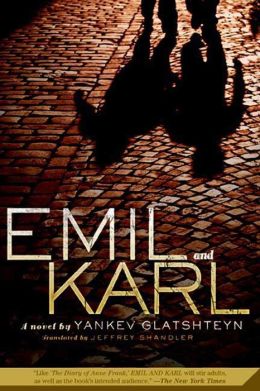
Emil and Karl. Yankev Glatshteyn. Translated from the Yiddish by Jeffrey Shandler. 1940/2006. Roaring Book Press. 208 pages.
I love the idea of loving Emil and Karl by Yankev Glatshteyn. Emil and Karl was written in 1940 in Yiddish. It is set in Austria. It is the first--or at least among the very first--book written for children about the persecution Jews were experiencing from the Nazis.
Emil and Karl have always, always been best friends. Emil's Jewish. Karl's the son of socialists. Both are "orphans" in a way because of the Nazis. The book opens with intensity: readers first glimpse of Karl is haunting. Karl's mother has been taken away by the Nazis. He's witnessed this: not only the arrest, but the beating too. He's alone in the apartment, feeling very alone, very frightened, very worried. For they told him they'd be back to take him too. He doesn't know what to do next, where to go, who to trust. He decides to run to Emil's house. Emil's world has also been devastated within the past day or two. His father was taken and killed. His mother is grieving and shattered.
Karl and Emil are very much on their own it seems. The two stick together no matter what. They'll face danger and be put into difficult situations time and time again. There are many scenes that stay with you.
But while I find the premise of this one fascinating, it isn't the absolute best book about the holocaust. It may be among the first, but, that doesn't make it among the best of the best. Worth reading? I think so if you already have an interest in the subject. But if you only read one book on the subject, I'd have to recommend you go with another book.
Showing posts with label Jewish. Show all posts
Wednesday, March 11, 2015
Wednesday, March 4, 2015
The Last Jews in Berlin
The Last Jews in Berlin. Leonard Gross. 1982/2015. Open Road Media. 343 pages.
The Last Jews in Berlin was a good read. It was oh-so-close to being a great read every now and then. What I loved about this one were the personal stories. These stories were the heart of the book. Readers get to meet dozens of people and follow their stories. As you can imagine, these stories can be intense.
Instead of telling each person's story one at a time, one after the other, the book takes a more chronological approach. The book is told in alternating viewpoints. Is this for the best? On the one hand, I can see why this approach makes it more difficult for readers to follow individuals, to keep track of each person's story. Just when you get good and attached to a certain person's narrative, it changes. It takes a page or two perhaps before you reconnect with the next narrator and get invested in that unfolding story. On the other hand, telling the story like this sets a certain tone, increases tension and suspense, and avoids repetition. So I can see why it makes sense. The method of storytelling didn't bother me.
Probably the one thing I learned from reading this is that there were Jews working with the Nazis and turning other Jews in. That there were Jews betraying one another trying to survive. One simply didn't know who to trust.
At the same time, the book shares stories of people who were trustworthy, people who were willing to risk their own lives to help Jews. Life was hard for everyone: but some were willing to share their food and open up their homes at great risk. The book did show that not every person supported the Nazis and their philosophy. There were people who disagreed and were willing to do the right thing.
It's an emotional book, very intense in places.
The Last Jews in Berlin was a good read. It was oh-so-close to being a great read every now and then. What I loved about this one were the personal stories. These stories were the heart of the book. Readers get to meet dozens of people and follow their stories. As you can imagine, these stories can be intense.
Instead of telling each person's story one at a time, one after the other, the book takes a more chronological approach. The book is told in alternating viewpoints. Is this for the best? On the one hand, I can see why this approach makes it more difficult for readers to follow individuals, to keep track of each person's story. Just when you get good and attached to a certain person's narrative, it changes. It takes a page or two perhaps before you reconnect with the next narrator and get invested in that unfolding story. On the other hand, telling the story like this sets a certain tone, increases tension and suspense, and avoids repetition. So I can see why it makes sense. The method of storytelling didn't bother me.
Probably the one thing I learned from reading this is that there were Jews working with the Nazis and turning other Jews in. That there were Jews betraying one another trying to survive. One simply didn't know who to trust.
At the same time, the book shares stories of people who were trustworthy, people who were willing to risk their own lives to help Jews. Life was hard for everyone: but some were willing to share their food and open up their homes at great risk. The book did show that not every person supported the Nazis and their philosophy. There were people who disagreed and were willing to do the right thing.
It's an emotional book, very intense in places.
Subscribe to:
Posts (Atom)