Showing posts with label review copy. Show all posts

Wednesday, March 11, 2015

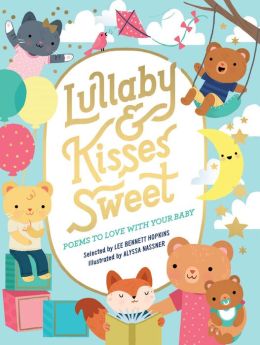
Lullaby & Kisses Sweet (2015)


Board Book: Lullaby and Kisses Sweet: Poems To Love With Your Baby. Selected by Lee Bennett Hopkins. Illustrated by Alyssa Nassner. 2015. Harry N. Abrams. 44 pages.

I really, really LOVE some of the poems included in this board book collection. The poems are arranged in five different sections: FAMILY, FOOD, FIRSTS, PLAY, and BEDTIME. I probably loved a poem or two (or three) from each section.

In FAMILY, I really loved "Grandma" by Prince Redcloud and "Car Seat" by Jude Mandell. Here's "Grandma":
When she takes my hand
and begins to sing
I love her more
than
anything.
In FOOD, I really loved "Spaghetti" by Laura Purdie Salas.

In FIRSTS, I really loved "First Word" by Joan Bransfield Graham

In PLAY, I really loved "Blocks" by Ann Whitford Paul and "Sandbox" by Stephanie Salkin.
Sand on my fingers, on my toes,
Sand on my chin, my ears, my nose,
Sand on my elbows, neck, and knees.
Take me out of this sandbox--
Please?
In BEDTIME, I really loved "Read to Me" by  Lee Bennett Hopkins.

There were so many good poems in this collection. I would find it very easy to recommend this one.

The illustrations complement the poems very well! They are very sweet--though I wouldn't say they are "precious." The illustrations are all of animal families. (There are lots of cat families which make me smile!)

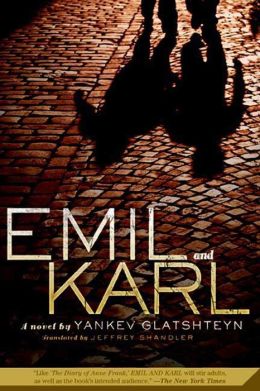
Emil & Karl (1940)

Emil and Karl. Yankev Glatshteyn. Translated from the Yiddish by Jeffrey Shandler. 1940/2006. Roaring Book Press. 208 pages.

I love the idea of loving Emil and Karl by Yankev Glatshteyn. Emil and Karl was written in 1940 in Yiddish. It is set in Austria. It is the first--or at least among the very first--book written for children about the persecution Jews were experiencing from the Nazis.

Emil and Karl have always, always been best friends. Emil's Jewish. Karl's the son of socialists. Both are "orphans" in a way because of the Nazis. The book opens with intensity: readers first glimpse of Karl is haunting. Karl's mother has been taken away by the Nazis. He's witnessed this: not only the arrest, but the beating too. He's alone in the apartment, feeling very alone, very frightened, very worried. For they told him they'd be back to take him too. He doesn't know what to do next, where to go, who to trust. He decides to run to Emil's house. Emil's world has also been devastated within the past day or two. His father was taken and killed. His mother is grieving and shattered.

Karl and Emil are very much on their own it seems. The two stick together no matter what. They'll face danger and be put into difficult situations time and time again. There are many scenes that stay with you.

But while I find the premise of this one fascinating, it isn't the absolute best book about the holocaust. It may be among the first, but, that doesn't make it among the best of the best. Worth reading? I think so if you already have an interest in the subject. But if you only read one book on the subject, I'd have to recommend you go with another book.

Tuesday, March 10, 2015

How To Catch A Bogle (2013)

How To Catch A Bogle. Catherine Jinks. Illustrated by Sarah Watts. 2013. HMH.

  I enjoyed reading How To Catch A Bogle a Victorian fantasy novel by Catherine Jinks. Birdie, the heroine, is an apprentice to Alfred the Bogler. She's bogle bait. Bogles are monsters who consume children. The action begins quickly in this one. Readers soon see Alfred and Birdie hard at work at this one. Birdie sings beautifully, baiting the trap if you will. Alfred carefully waits until just the right moment... Dangerous work it is. Is it too dangerous? One of Birdie's new acquaintances says it is. Miss Eames is something. She is very curious about bogles, about boglers. She wonders about the different types and classes of bogles--monsters or creatures. Where they live, how they live, what they eat, likes and dislikes, etc. She has a different approach than Alfred. Alfred is practical and skilled, but, not curious or scientific. Miss Eames is more interested in his work than he is in her work. She comes to really care for Birdie.

Miss Eames is not the only person interested in bogles. And there is one person whose interest is unethical....

Plenty of action and a bit of mystery!!! I enjoyed this one very much.

Saturday, March 7, 2015

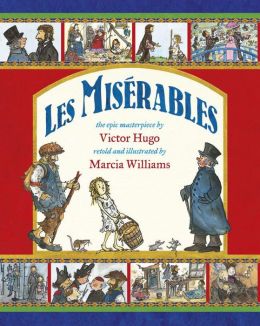
Les Miserables (2015)

Les Miserables The Epic Masterpiece by Victor Hugo, Retold and Illustrated by Marcia Williams. 2015. Candlewick. 64 pages.
POLICE NOTICE
It has come to my attention that you citizens known as "Les Miserables" believe that your wretched state of poverty and hunger is an excuse to flout the laws of France. You are mistaken. Every citizen must obey the law, and those who fail to do so will be punished.
Not a loaf of bread nor an apple from a tree will go missing without my learning of it. I will hunt down every criminal--rich or poor. The law shows no discrimination and no compassion.
I also warn all members of the revolutionary republican group "Les Amis de l'ABC" that your days are numbered. Should you seek to lead the miserable underdogs of our society to repeat the Revolution of 1789, you will fail!
The true citizens of France will not support you, and France will never again be a republic. King Louis XVIII is our monarch. He and the laws of France must be obeyed.
Inspector Javert
Les Miserables is one of my favorite classics. I love, love, love it. So I was quite excited to receive a review copy of this adaptation of Victor Hugo's classic. What did I think of it? Well, I liked it very much. At the very least, it does as good a job as any movie adaptation I've seen in capturing the story and the characters. So if you're looking to enjoy the story in its most basic form, this picture book adaptation wouldn't be a bad choice. Or, if you're looking to share this one with young readers, perhaps before seeing one of the movies, this one would be a fine choice.

I love the story. I love the characters. And Marcia Williams does a good job at remaining faithful to the story and the characters, of capturing why the story matters. The story is told through narration and dialogue (speech bubbles).

That being said, while it is a much shorter read--I read it in one sitting--it is not as wonderful as the original. One could argue it is more straightforward and focused and that it doesn't ramble. It doesn't have thousands of asides that take readers away from "main" story. But there is something beautiful in the original, even in the rambling. One of the things that I love most about original novel is the richness of it--the beauty of the language, the richness of the writing, the great attention to humanity. That is lost in this adaptation for the most part.

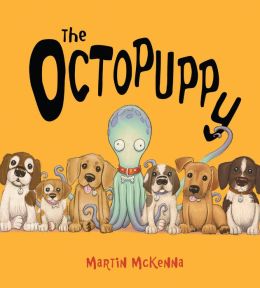
The Octopuppy (2015)

The Octopuppy. Martin McKenna. 2015. [March] Scholastic. 32 pages.

First sentence: Edgar wanted a dog. But Edgar didn't get a dog. He got Jarvis. Jarvis couldn't do anything a dog could do. But Edgar couldn't deny that Jarvis was clever.

Premise/Plot: Edgar, the hero, isn't pleased to receive an octopus instead of a puppy. He wants Jarvis to act just like a dog would. Jarvis is smart, and, now and then, Jarvis tries to act like a puppy. But he can't keep it up, Jarvis always goes back to being Jarvis. Edgar doesn't really appreciate that until it's too late. Jarvis does NOT want to stay where he's not wanted. Now that he's gone, Edgar regrets his behavior. Will these two be reunited.

My thoughts: What a strange, strange book. The good news? Well, readers can see for themselves and judge this book by its cover. The strangeness is not at all subtle. Did I like it? Not really. In fact, I really didn't like it at all. I found the scene where Jarvis flushes himself down the toilet to be disturbing!!! Will other readers like this plot twist? Perhaps! Who knows? But this book is not a good match for me.

Text: 2.5 out of 5
Illustrations: 2.5 out of 5
Total: 5 out of 10

Wednesday, March 4, 2015

The Last Jews in Berlin

The Last Jews in Berlin. Leonard Gross. 1982/2015. Open Road Media. 343 pages.

The Last Jews in Berlin was a good read. It was oh-so-close to being a great read every now and then. What I loved about this one were the personal stories. These stories were the heart of the book. Readers get to meet dozens of people and follow their stories. As you can imagine, these stories can be intense.

Instead of telling each person's story one at a time, one after the other, the book takes a more chronological approach. The book is told in alternating viewpoints. Is this for the best? On the one hand, I can see why this approach makes it more difficult for readers to follow individuals, to keep track of each person's story. Just when you get good and attached to a certain person's narrative, it changes. It takes a page or two perhaps before you reconnect with the next narrator and get invested in that unfolding story. On the other hand, telling the story like this sets a certain tone, increases tension and suspense, and avoids repetition. So I can see why it makes sense. The method of storytelling didn't bother me.

Probably the one thing I learned from reading this is that there were Jews working with the Nazis and turning other Jews in. That there were Jews betraying one another trying to survive. One simply didn't know who to trust.

At the same time, the book shares stories of people who were trustworthy, people who were willing to risk their own lives to help Jews. Life was hard for everyone: but some were willing to share their food and open up their homes at great risk. The book did show that not every person supported the Nazis and their philosophy. There were people who disagreed and were willing to do the right thing.

It's an emotional book, very intense in places.